
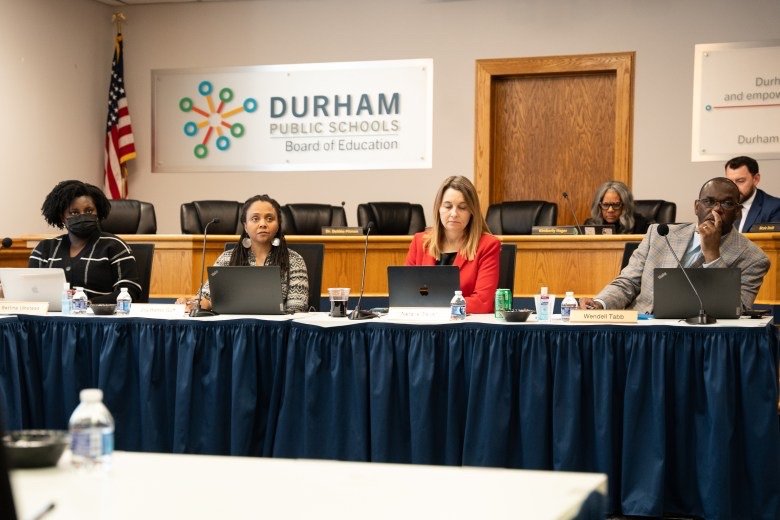
In a city wrestling with teacher shortages, budget pressures, academic recovery gaps and student safety concerns, an exchange over professional titles at a Durham Public Schools meeting has sparked debate far beyond the boardroom.
At issue was whether it was appropriate for the Durham Association of Educators (DAE) president to refer to Superintendent Dr. Anthony Lewis by his first name during a public meeting — and whether doing so signaled disrespect.
The moment triggered criticism, followed by an apology, and then a broader discussion about decorum, race, power and professionalism in public institutions.
But beneath the surface question — first name or formal title — lies a deeper conversation about how Durham defines respect and where civic energy should be directed.
What Happened
According to reporting from The News & Observer (Feb. 24), the DAE president publicly apologized after referring to Superintendent Lewis by his first name during a meeting. Some critics argued that in formal public settings, titles such as “Dr.” or “Superintendent” are customary and reflect institutional respect.
Others countered that both parties used informal address, suggesting the exchange reflected mutual familiarity rather than intentional disrespect.
The nuance matters.
Professional norms in public governance settings typically encourage the use of formal titles, especially in official proceedings. Parliamentary procedure guidelines and school board governance best practices often emphasize consistency in formal address to maintain decorum.
However, Durham’s civic culture is also shaped by grassroots organizing traditions and relational politics, where familiarity and first-name interactions are not uncommon.
The Racial Dimension
The controversy gained traction in part because of how it was framed. Some community voices suggested that informality toward a Black superintendent might carry racial undertones, particularly in historical contexts where professional titles were denied to Black leaders.
Others argued that if informality was mutual, framing the issue primarily through race risked oversimplifying the exchange.
Durham’s history complicates the discussion.
This is a city where race, education and power have long intersected — from desegregation battles to school funding fights to ongoing achievement gap disparities. Symbols and language often carry weight beyond their literal meaning.
“Titles can reflect respect, but context matters,” said a local governance expert familiar with school board procedure. “Consistency is key. If everyone is addressed formally, that signals professionalism. If everyone is informal, that signals familiarity. The problem arises when standards appear uneven.”
The Bigger Question: Focus and Proportion
What has surprised some residents is not the exchange itself, but the intensity of the reaction.
Durham Public Schools faces significant challenges:
• Ongoing teacher recruitment and retention struggles
• Budget debates over local and state funding allocations
• Pandemic-related learning recovery
• School safety concerns
• Infrastructure needs
Against that backdrop, some community members have questioned whether extended public debate over naming conventions diverts attention from systemic issues.
“Surely Durham has more pressing matters than who used which title,” one opinion writer argued in The News & Observer.
Yet others counter that professionalism and tone shape institutional trust — and trust affects everything from budget negotiations to classroom morale.
Public Perception and Political Undercurrents
Durham’s political environment is rarely static. Education debates often carry implications beyond the school system, influencing city council dynamics, county funding priorities and local elections.
The DAE, as a powerful educators’ association, plays a significant role in shaping school policy discourse. The superintendent’s relationship with educators is central to district stability.
When tensions surface publicly — even over language — observers often interpret them as signals of deeper friction.
Whether that interpretation is accurate remains open to debate. But perception itself can shape narrative momentum.
Why This Moment Matters
Durham’s civic identity rests on a balance between activism and institutional governance.
This episode highlights that tension.
On one side: expectations of formal professionalism in public institutions.
On the other: a culture rooted in direct, relational engagement.
Neither framework is inherently wrong. But misalignment between them can generate outsized reaction.
Ultimately, the exchange raises a broader civic question:
How does Durham define respect — and how should public officials model it?
The Opportunity
Moments like this can either deepen division or sharpen focus.
Durham residents will soon weigh in on school funding priorities, policy decisions and leadership direction. Those substantive issues remain urgent.
As always, The Bull City Citizen will continue examining not only what happens in public meetings, but what those moments reveal about governance, equity and the city’s future.
Because in Bull City, even small exchanges can illuminate larger truths.