
By any honest measure, the 2026 U.S. Senate race in North Carolina was already going to be brutal. Now it is something else entirely. It is a battlefield reshaped by forces 1,200 miles away.
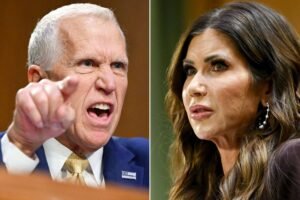
The Republican primary in Texas did not just produce a nominee. It produced chaos. And that chaos is about to land squarely on the shoulders of Michael Whatley.
If you think what happens in Texas stays in Texas, you are not paying attention.
The Money Problem Republicans Cannot Ignore
Control of the United States Senate hangs by a thread. Republicans cannot afford to lose seats they already hold. Yet in Texas, what should have been a routine renomination turned into a resource-draining spectacle. A runoff means millions of additional dollars spent. It means outside groups forced to triage. It means donor networks stretched thin.
Every dollar spent rescuing a seat in Texas is a dollar not spent defining Roy Cooper in North Carolina.
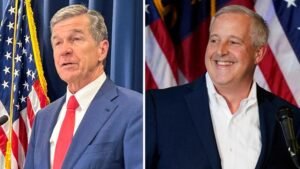
And make no mistake. Roy Cooper is not a first-time statewide candidate struggling for oxygen. He is a four-time statewide winner who has never lost a general election in more than three decades of public life. He knows how to run the table from the mountains to the coast. He knows how to squeeze margins out of rural counties while running up the score in urban centers like Durham.
If national Republicans are forced to divert money to Texas, Whatley faces a nightmare scenario. He becomes the underfunded candidate running against the most battle-tested Democrat in the state.
What This Means for Durham
Durham is not a political afterthought in this race. It is ground zero for turnout. In recent statewide elections, Durham County has delivered some of the largest Democratic margins in North Carolina. When turnout surges here, Democrats win statewide. When it dips, Republicans survive.
Cooper understands this terrain. His political brand was built in part on coalition building across urban and suburban North Carolina. He expanded Medicaid after years of partisan stalemate. He leaned into education funding. He framed himself as pragmatic rather than ideological.
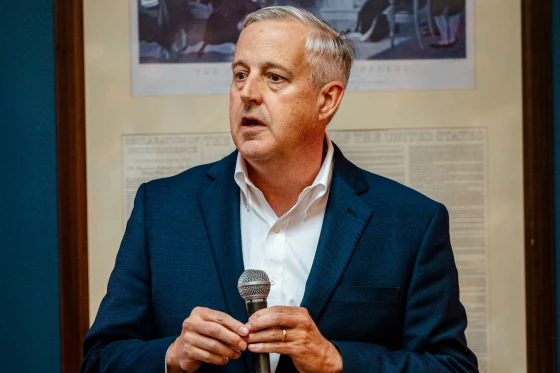
Whatley enters this race with a different profile. A former state and national party chairman, he is known more inside Republican circles than at Durham coffee shops or PTA meetings. His identity is tightly tethered to national conservative leadership. That may energize a base primary electorate. It is far less clear how it plays with unaffiliated voters in Wake and Durham counties who decide general elections.
Durham’s electorate is highly educated, racially diverse and deeply engaged in national issues from health care to climate policy. These voters are not casual observers. They will scrutinize positions on abortion rights, federal research funding, student loan policy and infrastructure investment. A candidate defined primarily by party machinery rather than policy fluency faces an uphill climb here.
A Structural Disadvantage Gets Worse
North Carolina is a true battleground. Presidential races are decided by razor thin margins. Senate contests often mirror that divide. But open seats are unpredictable, and unpredictability favors the candidate with broader appeal and deeper name recognition.
Cooper has both.
Whatley needs three things to win. Full Republican unity. Massive national financial support. A disciplined pivot to moderate and independent voters.
The Texas primary complicates at least two of those.
If Republican infighting drains enthusiasm or funds, Whatley cannot simply will resources into existence. Super PACs make strategic decisions. National committees prioritize survival. Texas is now a triage patient.
Meanwhile Democrats are salivating at the map. They need a net gain to flip the Senate. North Carolina is their clearest offensive opportunity. Cooper’s candidacy transformed this from a long shot to a frontline battle overnight.
The Brutal Math of 2026
Let us speak plainly. If Republicans are forced to defend Texas with emergency spending, North Carolina becomes more expensive and more competitive at the same time. That is a strategic disaster.
Cooper can afford to stay above the fray early, stockpile cash and define Whatley before he fully defines himself. Whatley, by contrast, must introduce himself statewide while simultaneously countering a Democrat who has been on ballots since the 1980s.
Durham will be central to that fight. Duke University, North Carolina Central University and the broader Research Triangle are engines of turnout and political energy. Federal policy decisions made by the next senator will affect biomedical research grants, student aid and regional infrastructure dollars. Voters here understand the stakes.
This Is No Longer a Standard Senate Race
The Texas primary did not just add drama to another state’s ballot. It tightened the vise on Michael Whatley’s campaign before the general election has even begun in earnest.
North Carolina Republicans once hoped to frame this race as a referendum on national Democratic leadership. Now they must first answer whether their own national strategy is coherent.
Durham voters will not be passive spectators. They will be participants in what may become the most expensive and volatile Senate race in the country.
If Texas continues to bleed Republican resources and unity, North Carolina could become the state that tips the balance of power in Washington.
And if that happens, the tremors that began in a Texas primary will echo all the way to Bull City.