
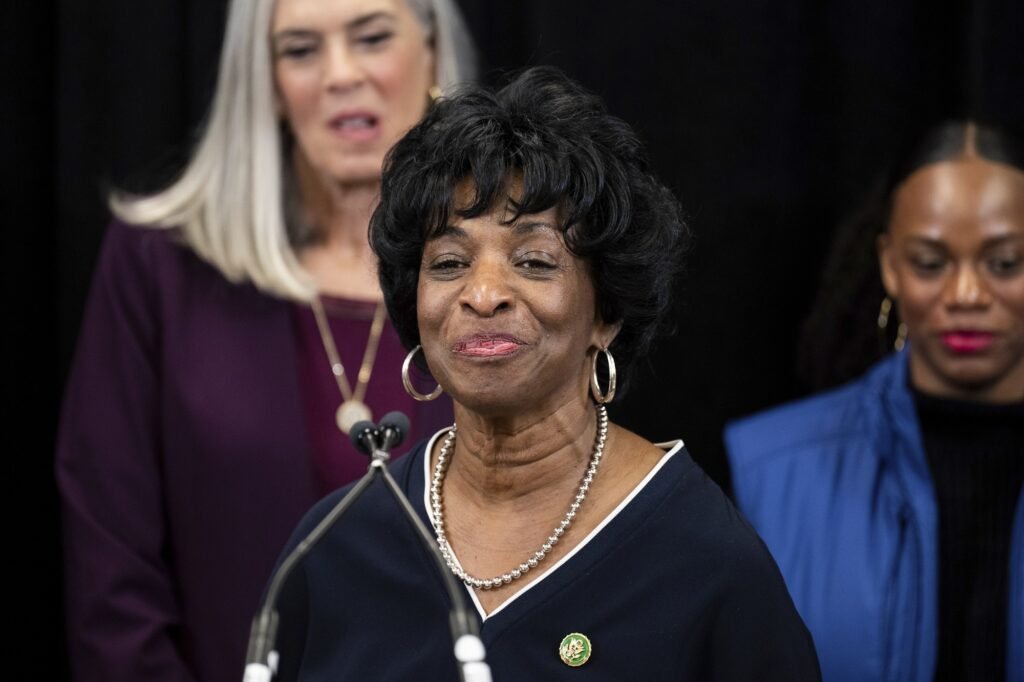
Four years ago, Rep. Valerie Foushee’s support for Israel aligned comfortably with mainstream Democratic foreign policy and helped solidify backing from key constituencies during her successful congressional campaign.
Today, that same record has become a point of vulnerability.
As North Carolina voters head to the polls for the March 3 primary, the Durham-based Democrat faces a challenge shaped not only by local issues, but by a broader ideological shift within the Democratic Party over U.S. policy toward Israel and the Middle East.
What was once consensus is now contested terrain.
A Changing Party Landscape
Rep. Foushee, who represents North Carolina’s 4th Congressional District — which includes Durham, Chapel Hill and parts of Raleigh — has supported traditional U.S.-Israel security cooperation. Congressional records show she voted in favor of supplemental aid packages for Israel and opposed efforts to condition military assistance on human rights benchmarks.
Such positions historically reflected bipartisan orthodoxy in Washington. But in the years since the escalation of violence in Gaza and the widening humanitarian crisis, Democratic voters — particularly younger and urban voters — have shown increasing skepticism toward unconditional U.S. support.
Polling by Pew Research Center in recent years has shown a growing divide within the Democratic Party, with younger Democrats expressing more critical views of Israel’s government and stronger sympathy for Palestinians compared to older Democrats.
That generational shift is now playing out in primaries across the country.
Durham’s Unique Political Climate
Durham is not an ordinary congressional district.
It is home to Duke University, North Carolina Central University and a politically active electorate shaped by academic discourse, civil rights legacy and strong grassroots organizing traditions.
Campus demonstrations related to the war in Gaza have drawn national attention. Student groups and faculty organizations have debated ceasefire resolutions, divestment proposals and U.S. military aid policy. Those debates have filtered into local campaign rhetoric.
“Foreign policy feels closer to home than it used to,” said a Durham-based political analyst. “When you have universities this engaged, national issues quickly become local tests of values.”
The Primary Challenge
Primary challengers have framed Foushee’s Israel votes as evidence that she is out of step with a changing base. Campaign messaging has emphasized calls for a permanent ceasefire, restrictions on military aid and stronger congressional oversight of U.S. foreign assistance.
Foushee, for her part, has defended her record as balanced and security-minded, arguing that supporting Israel’s right to defend itself does not preclude advocating for humanitarian protections.
In public statements, she has emphasized the need for a two-state solution, protection of civilians and sustained diplomacy.
The race reflects a broader Democratic tension: whether elected officials should recalibrate long-standing alliances in response to grassroots pressure.
National Context
Foushee’s race is not occurring in isolation.
Across the country, incumbents in safely Democratic districts are facing primary challenges from candidates arguing that party leadership has not gone far enough in criticizing Israel’s military actions. In some cases, pro-Israel political action committees have responded with substantial campaign spending to defend incumbents.
The resulting primaries have become referenda not just on individual lawmakers, but on the party’s foreign policy direction.
Political observers note that Democratic primaries increasingly function as ideological sorting mechanisms, particularly in districts where the general election outcome is not in doubt.
What It Means for Durham Voters
For Durham residents, the primary raises questions beyond foreign policy.
Some voters see the debate as a matter of moral clarity. Others view it as a question of pragmatic governance.
“There’s a real conversation happening about what representation means,” said a local civic organizer. “Is it about reflecting the loudest voices in the moment, or balancing competing priorities over time?”
Economic issues, housing affordability, infrastructure funding and education policy remain central to many Durham voters. Yet foreign policy has emerged as an unexpected but potent factor in this election cycle.
The Broader Electoral Stakes
North Carolina’s 4th District is heavily Democratic, meaning the primary winner is highly likely to win the general election.
That reality intensifies the stakes of the March 3 vote. Primary turnout in Durham often skews toward highly engaged voters — those most attentive to national and international debates.
As Election Day approaches, campaign volunteers have canvassed neighborhoods from Southpoint to downtown, emphasizing turnout among younger voters and longtime party loyalists alike.
A Party in Transition
The debate surrounding Rep. Foushee’s support for Israel reflects something larger than one campaign.
It signals a Democratic Party navigating generational change, shifting geopolitical realities and evolving moral frameworks around U.S. military alliances.
In Durham, where civic engagement runs deep and political consciousness is high, those tensions are amplified.
Whether voters ultimately decide that Foushee’s record represents steady leadership or outdated orthodoxy will be determined at the ballot box.
As Durham heads into one of the most closely watched primaries in recent memory, The Bull City Citizen will continue tracking turnout trends, campaign finance data and voter sentiment.
Because in Bull City, even global debates can decide local elections.